Being legal-tech researchers, we are often approached by individuals or organizations requesting us to promote or recommend their businesses. Our standard practice is to carefully review their business profile, expertise, operations, and legal standing before offering any opinion. However, a recent incident compelled us to revisit the laws and circumstances surrounding the promotion, suggestion, and/or recommendation of businesses on public platforms.
On 17th August 2025, the police arrested popular YouTuber Saadur Rehman (better known as Ducky Bhai, a social media influencer) at Allama Iqbal International Airport, Lahore, Pakistan. He was charged with promoting online gambling applications and allegedly laundering money through them. The incident raised critical questions about the responsibilities and liabilities of celebrities and influencers who promote products, services, or platforms to the general public.
Before delving into the role of social media influencers, it is important to consider the position of traditional celebrities who advertise products on national and international media. Typically, female celebrities endorse beauty or fashion-related products, while male celebrities often promote male-oriented products. But the pertinent question remains: Do celebrities personally use the products they endorse? And if those products cause harm, who bears the legal responsibility, the manufacturer, the celebrity, or the advertising company?
From a legal perspective, the primary responsibility rests with the manufacturer. However, the secondary responsibility may extend to the celebrity and the advertising agency. This secondary liability is crucial to understand, as it determines whether endorsers can be held accountable for harm caused to consumers.
A celebrity is essentially an endorser, a public figure who uses their influence to attract consumers toward a product or service. Their liability depends on knowledge and due diligence:
= If the celebrity knew or should have known that the product was harmful, they may be held liable for negligent misrepresentation or false advertising.
= In many jurisdictions, particularly after the Federal Trade Commission (FTC) guidelines in the USA and Advertising Standards Council of India (ASCI) in India, celebrities are required to verify product claims before endorsing them.
Penalties for violating these regulations can include heavy fines, disqualification from endorsements, and even being made a party to civil suits.


For example, under India’s Consumer Protection Act, 2019, celebrities may be held liable for endorsing misleading products if they fail to exercise due diligence.
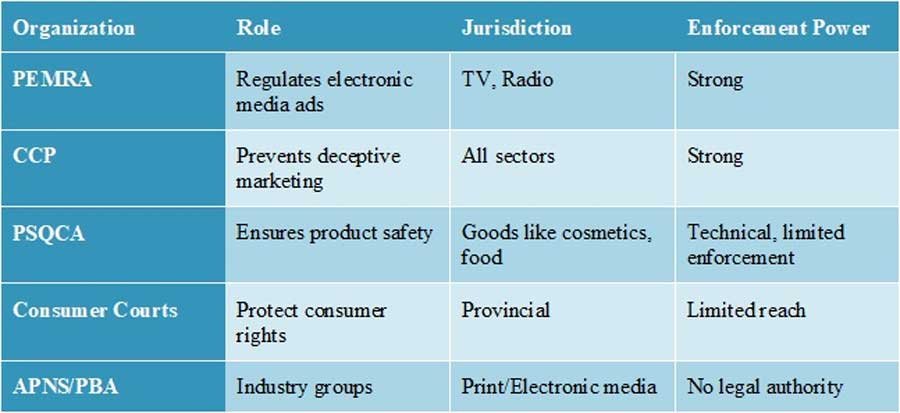
In Pakistan, the following authorities regulate endorsements, advertising, and consumer protection:
Under Pakistani consumer protection laws, endorsers can be held liable if they knowingly promote misleading claims. For instance:
= If a celebrity exaggerated a beauty cream’s benefits (e.g., “guaranteed to clear skin”) without scientific evidence, they could be partially liable.
= If they were aware (or should reasonably have been aware) that the product was unsafe, they could face legal action for negligence or fraud.
= While contracts with manufacturers or ad agencies may attempt to limit liability, such contracts cannot override consumer protection laws if the endorsement itself caused harm.
Thus, celebrities cannot be fully exonerated when their endorsements mislead the public or result in harm.
This naturally raises the question: Do the same rules apply to social media influencers?
Social Media Influencers: A New Frontier
The role of influencers has become so significant that several countries have already begun regulating them. A key example is France’s Law No. 2023-451 of June 9, 2023, introduced by MPs Arthur Delaporte and Stéphane Vojetta. This law creates a legal framework to regulate influencers, their agents, advertisers, and platforms, addressing scams, fraudulent promotions, and the abuse of consumer trust.
This law defines new legal categories in France:
Influencer (“person engaging in commercial influence through electronic means”) as an individual who, for remuneration or in-kind benefits, uses their notoriety to promote goods, services, or causes online, and
Influencer Agent as a person representing influencers for consideration in such promotions. Influencers, agents, and advertisers must enter written contracts above a remuneration threshold (set by decree), including mandatory clauses like assigned missions, payment conditions, and submission to French law when targeting French subscribers.
The law establishes joint liability among influencers, agents, and advertisers for damages caused to third parties under commercial influence contracts (Article 8 III). It prohibits influencers from promoting financial contracts, digital asset services, or digital assets (e.g., cryptocurrencies, utility tokens) unless registered or approved as a Digital Asset Service Provider (DASP) by the AMF. Non-DASP-approved digital assets (e.g., NFTs) may be promoted, but Initial Coin Offerings (ICOs) require an AMF visa. The bill also prohibits the promotion of:
= Sports advice or predictions;
= Professional training courses via the Personal Training Account (CPF) in exchange for remuneration or a product;
= Gambling and games of chance, unless the promotion is limited to a platform that has the “technical capability” to exclude underage users.
This framework is particularly relevant given the growing risks posed by influencers promoting gambling apps, crypto schemes, or unsafe health products.
Gambling Laws: A Comparative Glance
Since the arrest of Ducky Bhai revolved around gambling apps, it is important to briefly review gambling laws of nearby countries:
Conclusion
The arrest of a prominent Pakistani YouTuber highlights a pressing reality: influencers and celebrities are not just entertainers; they are powerful opinion leaders whose endorsements can shape consumer decisions, for better or worse. With this power comes responsibility.
Celebrities and influencers must exercise due diligence before endorsing any product, particularly those with potential legal or health risks, such as gambling apps, financial schemes, or cosmetic products. Similarly, governments must act proactively, as France has done, to regulate this sector and protect the public from misleading promotions.
It is manifestly proved that social media influence is no longer a casual activity; it is a commercial enterprise with legal obligations. Until Pakistan and other countries modernize their laws to regulate this industry, the public will remain vulnerable to exploitation. The time has come for lawmakers, regulators, and influencers themselves to recognize this responsibility and act accordingly.
The post The hidden risks of promotion: Legal obligations for influencers in a digital age appeared first on The Financial Daily.