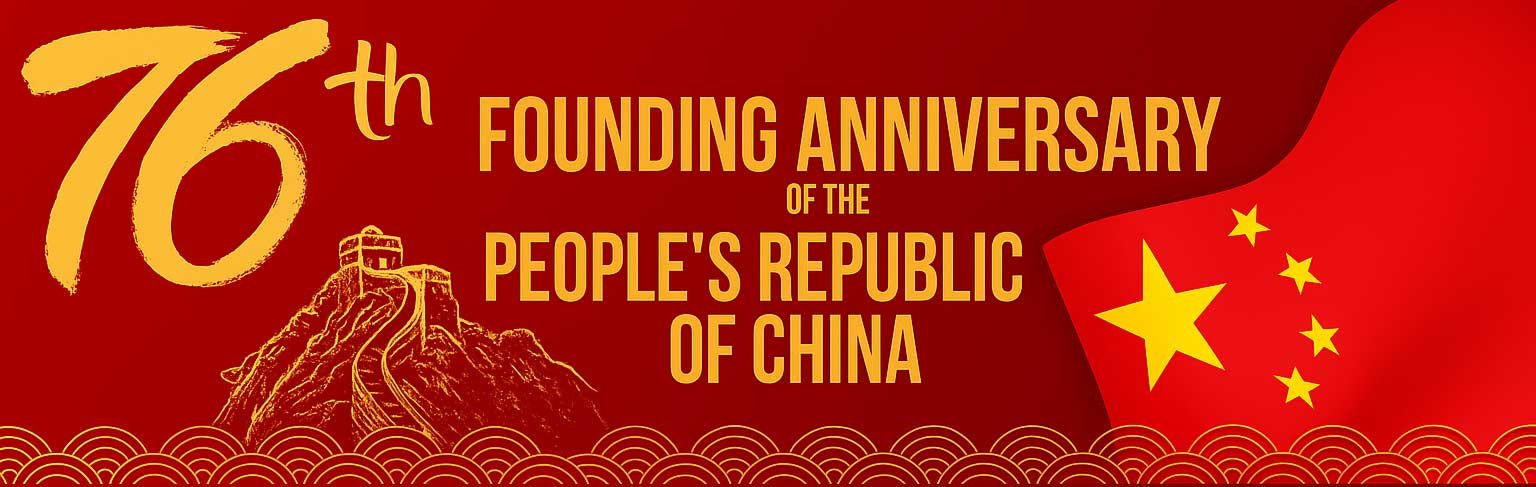


China is celebrating its 76th National Day on 1st October this year. This occasion is not only a reflection on China’s political accomplishments but also a celebration of its monumental economic transformation. If we look back at history, in 1949 China was emerging from the devastation of war, struggling with a fragile agricultural economy. The country was fragmented, its vast population trapped in poverty, literacy rates were low, and infrastructure was weak. Yet, even at that time, the visionary leadership equipped the nation with effective strategies, instilling resilience and preparing its people to compete with global powers.
In just seven and a half decades, China has undergone a remarkable transition. The early leadership concentrated on centralized planning, collective farming, and industrial development. Despite the hardships of the Great Leap Forward and the Cultural Revolution, these years laid the foundation of a system that gradually strengthened education, healthcare, and industry-preparing the ground for later reforms. The early years of the People’s Republic were about survival and state-building, creating institutions strong enough to unify such a vast and diverse nation. By the 1960s, literacy campaigns, expansion of primary education, and the initial industrial drive created a population ready to embrace later reforms. These foundational steps ensured that when China turned toward modernization, the human capital was better prepared than before.
The defining moment in China’s economic history came in 1978, when Deng Xiaoping initiated a series of reforms and the “opening-up” policy. China began shifting from a centrally planned economy to a socialist market economy, introducing liberalization and establishing Special Economic Zones (SEZs) such as Shenzhen to attract foreign investment and technology. These pragmatic reforms expanded industries and infrastructure, integrating China into global trade. Over the following decades, China became an export-led growth economy, driven by large-scale manufacturing and an efficient labor force. Deng’s policies also empowered rural households by dismantling collective farms and replacing them with the Household Responsibility System, which allowed families to retain surpluses. This reform boosted agricultural productivity and created the surplus labor force that fueled industrial growth in cities. By the 1990s, villages were connected to urban centers, and millions migrated to cities, accelerating urbanization and expanding domestic consumption.
China’s transformative journey continued into the 1990s, with effective expansion policies that culminated in its accession to the World Trade Organization (WTO) in 2001. This move embedded China into global value chains and elevated its role in the world economy. Massive infrastructure development, coupled with its vast labor force, enabled China to become a low-cost, high-volume manufacturing hub. With GDP growth averaging nearly 10% annually-an unparalleled feat in modern economic history-hundreds of millions were lifted out of poverty, creating the world’s largest middle class. At the same time, China invested heavily in mega-projects like the Three Gorges Dam, high-speed rail networks, and modern ports, which not only boosted economic activity but also symbolized China’s entry into the league of modern nations. Throughout this journey, the state focused on social stability, technological advancement, and policy reforms to preserve the fabric of society.
Under the leadership of President Xi Jinping, China has reoriented its strategy from sheer economic proliferation toward value-driven development, innovation, and sustainability. The Belt and Road Initiative (BRI) exemplifies China’s ambition to reshape global economic networks through infrastructure investments across Asia, Europe, and Africa. The initiative reflects not only China’s capacity for global outreach but also its vision of a more connected world, with ports, railways, and energy corridors knitting continents together. The “Made in China 2025” plan underscores its intent to move beyond low-cost production into advanced sectors such as artificial intelligence, robotics, semiconductors, and green technologies. These policies aim to transition China from the “world’s factory” to a global innovation powerhouse. At the same time, Xi’s emphasis on “dual circulation”-strengthening domestic demand while maintaining global engagement-shows a forward-looking strategy to insulate China from external shocks.
China’s resilience has been tested during global crises. During the 2008 financial downturn and again amid the COVID-19 pandemic, China faced economic and geopolitical pressures head-on. Its leadership responded with stimulus measures, swift pandemic control strategies, and continued manufacturing of essential goods. Even in times of slowed global activity, China remained the engine of world growth, contributing nearly one-third of global GDP. Moreover, China emerged as a leader in renewable energy and sustainable technologies, aligning its economic ambitions with global environmental commitments. Today, China leads the world in solar and wind energy capacity, invests heavily in electric vehicles, and works on becoming carbon neutral by 2060. These initiatives reflect a recognition that economic power in the 21st century is inseparable from ecological responsibility.
As China marks its 76th National Day, the country is focused on innovative solutions to achieve its long-term goals. For the global community, China’s rise as a leading economy is both an opportunity and a challenge. Its growing influence in trade, technology, and finance has positioned it as a formidable force that no country can ignore. At seventy-six, China exemplifies resilience, strategic vision, and pragmatic policymaking. From the hardships of 1949 to its current position as an economic powerhouse, China’s story reflects the power of visionary leadership, governance, and foresight.
Over the decades, China has transformed from an agrarian society into the world’s second-largest economy, advancing through industrialization, infrastructure, and integration into global trade. Now it is positioning itself to reach high-income status. Its future direction is centered on technological advancement, sustainable development, and balanced regional growth, with increasing focus on blue and green economies. Simultaneously, initiatives such as the Belt and Road and the Shanghai Cooperation Organization illustrate its vision of shifting global influence from West to East. This broader geopolitical role, combining economic strength with diplomatic initiatives, signals China’s determination to play a leading role in global governance.
China’s trajectory holds powerful lessons for developing nations. It demonstrates that poverty and underdevelopment are not permanent conditions, but challenges that can be overcome through determination, vision, and consistent policies. Developing countries can learn from China’s blend of state direction and market dynamism, its prioritization of education and human capital, and its capacity to think in decades rather than election cycles. The message is simple yet profound: the will to change can shape a nation’s destiny.
The post China : From Struggle to Global Economic Leadership appeared first on The Financial Daily.